Quick answer: GIREVE is Europe's leading EV charging roaming hub, connecting hundreds of CPOs and eMSPs across much of Europe. You connect through a single OCPI 2.1.1 or 2.2.1 integration, then pass registration, technical setup, and certification before going live — reaching millions of drivers without building new infrastructure or hundreds of direct partner connections.
GIREVE is the leading EV charging roaming platform in Europe, connecting hundreds of Charge Point Operators (CPOs) and e-Mobility Service Providers (eMSPs) across much of Europe. Founded in 2013 and based in France, GIREVE operates as a neutral hub that enables interoperability between charging networks — allowing EV drivers to charge on any connected network with a single subscription or payment method.
For any company operating or providing access to EV chargers in Europe, connecting to GIREVE is one of the most effective ways to reach millions of EV drivers and expand network coverage without building new infrastructure.
How Does GIREVE Work?
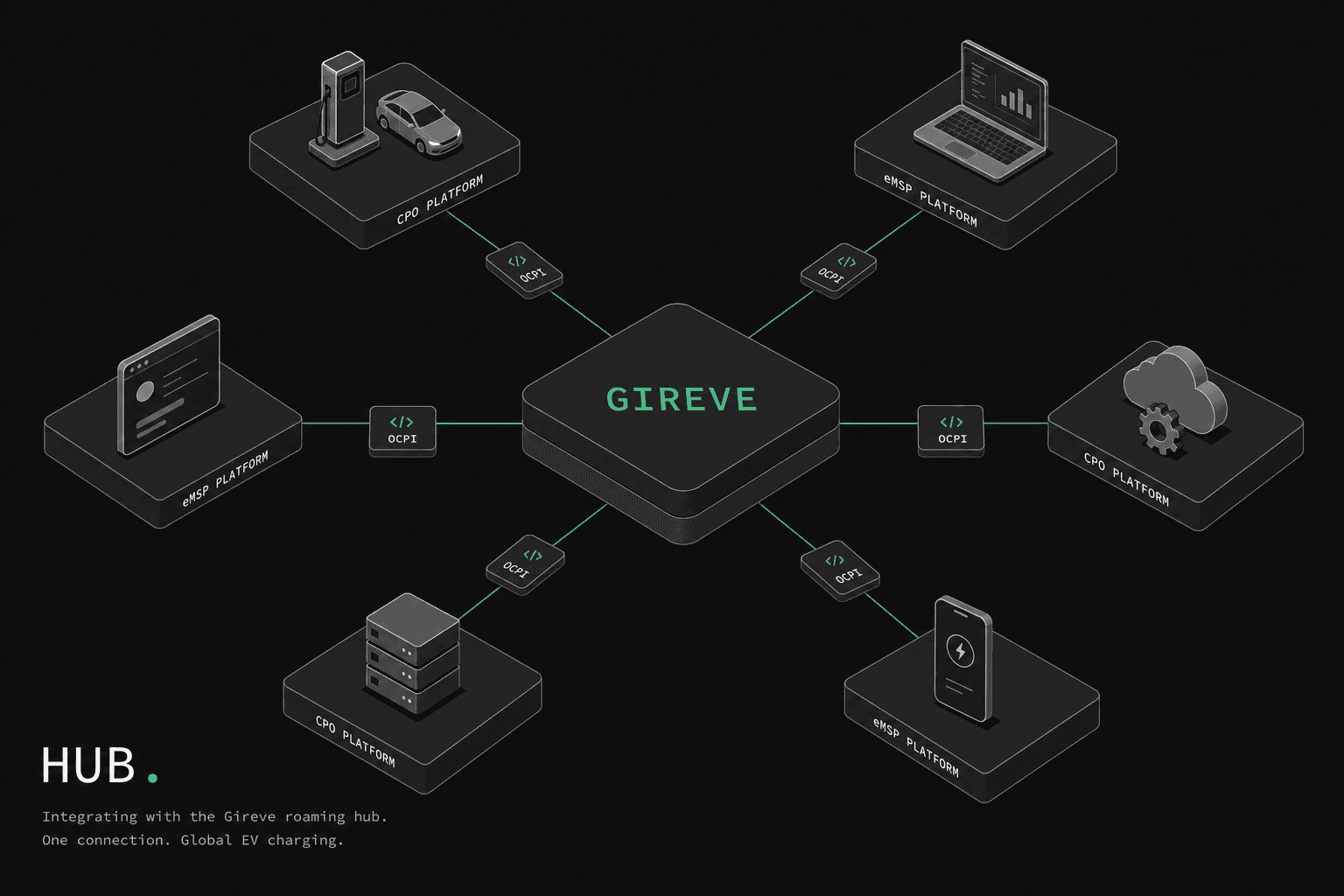
GIREVE operates as a B2B roaming hub, sitting between CPOs and eMSPs:
- CPOs connect to GIREVE and publish their charger locations, availability, pricing, and capabilities
- eMSPs connect to GIREVE and receive this aggregated data to display in their driver apps
- When a driver on eMSP-A wants to use a charger operated by CPO-B, GIREVE routes the authorization request between them
- After charging, GIREVE handles the CDR (Charge Detail Record) exchange for billing and settlement
The Hub Model vs Direct Connections
Without a hub, a CPO wanting to enable roaming with 50 eMSPs would need 50 separate integrations. A hub reduces this to a single integration:
| Approach | Connections for 50 Partners | Maintenance |
|---|---|---|
| Direct (Peer-to-Peer) | 50 separate integrations | 50 APIs to maintain |
| Hub (via GIREVE) | 1 integration | 1 API to maintain |
This is why roaming hubs have become the standard architecture in European EV charging.
What Are GIREVE's OCPI Integration Requirements?
GIREVE uses OCPI (Open Charge Point Interface) as its primary integration protocol, the open roaming standard maintained by the EVRoaming Foundation. Specifically, GIREVE supports OCPI 2.1.1 and OCPI 2.2.1.
Required OCPI Modules
To connect with GIREVE, you must implement specific OCPI modules depending on your role:
For CPOs:
| Module | Purpose | Required |
|---|---|---|
| Credentials | Authentication and version handshake | Yes |
| Locations | Publish charger locations, EVSEs, and connectors | Yes |
| Sessions | Share real-time charging session data | Yes |
| CDRs | Send Charge Detail Records for billing | Yes |
| Tariffs | Publish pricing information | Yes |
| Commands | Receive remote start/stop commands from eMSPs | Recommended |
| Tokens | Receive driver authorization tokens | Yes |
For eMSPs:
| Module | Purpose | Required |
|---|---|---|
| Credentials | Authentication and version handshake | Yes |
| Locations | Receive charger location data from CPOs | Yes |
| Sessions | Receive real-time charging session data | Yes |
| CDRs | Receive Charge Detail Records for billing | Yes |
| Tariffs | Receive pricing information | Yes |
| Commands | Send remote start/stop commands to CPOs | Recommended |
| Tokens | Publish driver authorization tokens | Yes |
Technical Requirements
- REST API: OCPI is a REST-based protocol using JSON over HTTPS
- Authentication: Token-based authentication (OCPI credentials exchange)
- TLS: All connections must use TLS 1.2 or higher
- Availability: Your OCPI endpoints must maintain high uptime (GIREVE enforces strict availability thresholds)
- Response Time: API responses should be fast; GIREVE monitors endpoint latency
- Data Quality: Location data must be accurate and regularly updated
For a deeper walkthrough of the underlying protocol flows, see our guide to implementing OCPI roaming.
How Do You Connect to GIREVE?
Step 1: Registration
Contact GIREVE to initiate the partnership process. You will need to provide:
- Company legal information
- Technical contact details
- Your role (CPO, eMSP, or both)
- Network size and geographic coverage
- Target OCPI version (2.1.1 or 2.2.1)
Step 2: Technical Integration
GIREVE provides access to their IOP (Interoperability Platform), which includes:
- A staging environment for development and testing
- Technical documentation and OCPI implementation guides
- API endpoints for credential exchange and module registration
- Test tools for validating your OCPI implementation
Step 3: Certification
Before going live, GIREVE requires passing their certification process:
- Protocol compliance: Your OCPI implementation must pass GIREVE's automated test suite
- Data quality: Location data accuracy is validated (coordinates, addresses, connector types)
- Operational readiness: Uptime, response time, and error rate thresholds must be met
- Business validation: Tariff structures and CDR formats are reviewed
Step 4: Go Live
Once certified, your connection is activated in production:
- CPOs: Your chargers become visible to all connected eMSPs
- eMSPs: You gain access to charger data from all connected CPOs
- GIREVE monitors the connection and alerts on any issues
Step 5: Ongoing Operations
After going live, you must maintain:
- Real-time data synchronization (location updates, availability changes)
- Timely CDR processing (typically within 24 hours of session completion)
- Response to GIREVE operational alerts and maintenance windows
- OCPI version upgrades when announced
Why Connect to GIREVE?
For CPOs
- Increased utilization: Access to millions of EV drivers across a large network of connected eMSPs
- Revenue growth: Roaming transactions generate additional revenue without marketing spend
- European coverage: Visibility across charging networks throughout Europe
- Simplified billing: GIREVE handles financial settlement with all roaming partners
- Regulatory compliance: AFIR (Alternative Fuels Infrastructure Regulation) encourages roaming
For eMSPs
- Network expansion: Offer your drivers access to a large European charging network — as of early 2026, GIREVE's roaming barometer reported roughly 695,000 connected charge points across Europe
- Single integration: One connection replaces hundreds of direct CPO integrations
- Real-time data: Live availability, pricing, and session monitoring
- Billing automation: CDR exchange and settlement handled by the platform
- Competitive advantage: Comprehensive charging coverage attracts more subscribers
How Does GIREVE Compare to Other Roaming Hubs?
GIREVE is one of several roaming hubs operating in Europe, each with different strengths and protocol support (see our OCPI vs OICP vs OCHP comparison):
| Feature | GIREVE | Hubject | e-clearing.net |
|---|---|---|---|
| Headquarters | France | Germany | Belgium |
| Founded | 2013 | 2012 | 2009 |
| Primary Protocol | OCPI | OICP (proprietary) | OCPI + OCHP |
| OCPI Support | Native (2.1.1, 2.2.1) | Via adapter | Native |
| Plug & Charge | Developing | Yes (ISO 15118 PKI) | No |
| Geographic Strength | France, Southern Europe | Germany, Central Europe | Benelux, Nordics |
| Pricing Model | Per-transaction fee | Per-transaction fee | Per-transaction fee |
| Certification Process | Required | Required | Required |
| Open Protocol | Yes (OCPI) | No (OICP proprietary) | Yes (OCPI/OCHP) |
Choosing a Roaming Hub
Many companies connect to multiple hubs to maximize coverage. Consider:
- Geography: Choose the hub strongest in your target markets
- Protocol: If you already have OCPI implemented, GIREVE and e-clearing.net are natural fits
- Plug & Charge: If ISO 15118 Plug & Charge is a priority, Hubject currently leads with its PKI infrastructure
- Partners: Check which hub your key partners are already connected to
- Cost: Compare per-transaction fees and any fixed membership costs
Common Integration Challenges
Data Quality Issues
The most frequent reason for failed GIREVE certification is poor location data:
- GPS coordinates that do not match the actual charger location
- Missing or incorrect connector type information
- Outdated availability data (chargers shown as available when offline)
- Incomplete address information
Tariff Complexity
European EV charging tariffs are complex, varying by time of day, energy consumed, charging duration, and subscription status. Your OCPI tariff module must accurately represent these structures.
CDR Reconciliation
Discrepancies between CPO and eMSP CDR records cause billing disputes. Common causes include:
- Time zone mismatches in session timestamps
- Rounding differences in energy measurements
- Missing or delayed CDR delivery
- Inconsistent tariff application
Performance Under Load
GIREVE sends location and session updates at high frequency. Your OCPI endpoints must handle sustained traffic without degradation — particularly the Locations and Sessions modules during peak hours.
Testing Your GIREVE Integration
GIREVE integration involves complex multi-party flows that are difficult to test without a controlled environment. Issues discovered during certification can delay your go-live by weeks or months.
OCPPLab helps you prepare for GIREVE integration testing by letting you:
- Simulate OCPI endpoints: Test your CPO or eMSP implementation against realistic OCPI traffic patterns
- Validate data quality: Generate and verify location data, tariff structures, and CDR formats before submitting to GIREVE
- Test end-to-end flows: Simulate a complete roaming transaction from eMSP authorization through CPO charging session to CDR settlement
- Load test OCPI modules: Verify your endpoints handle the traffic volume GIREVE will generate
- Debug protocol issues: Inspect every OCPI request and response with full payload logging
- Test OCPP + OCPI together: Validate that your CPMS correctly translates between OCPP charger communication and OCPI roaming data
Organizations that pre-validate their OCPI implementation using OCPPLab typically pass GIREVE certification on the first attempt, avoiding costly delays.
Frequently Asked Questions
How long does GIREVE integration take?
The typical timeline is 3-6 months from initial contact to production. Technical integration takes 4-8 weeks, certification 2-4 weeks, and business/legal setup runs in parallel.
How much does GIREVE connection cost?
GIREVE charges a per-transaction fee for roaming sessions. The exact pricing depends on your volume and is negotiated during the partnership setup. There may also be an annual platform fee.
Can I connect to GIREVE and Hubject simultaneously?
Yes. Many CPOs and eMSPs connect to multiple hubs. Your OCPI implementation serves GIREVE, and a separate OICP (or OCPI adapter) integration serves Hubject. Be aware of potential duplicate roaming sessions if a partner is on both hubs.
Do I need OCPI 2.2.1 or is 2.1.1 sufficient?
GIREVE supports both versions. OCPI 2.1.1 covers all core roaming functionality and is currently the most widely deployed. OCPI 2.2.1 adds hub-specific features and improved tariff handling. GIREVE may eventually require 2.2.1, so implementing it from the start is advisable.
Is GIREVE only for European networks?
GIREVE's primary coverage is Europe, but they are expanding internationally. If your network operates outside Europe, check with GIREVE about coverage in your region. For Asia-Pacific or North American roaming, other platforms may provide better coverage.
What is the difference between GIREVE and eMI3?
eMI3 (eMobility ICT Interoperability Innovation) defines data standards and identifiers (like the eMI3 ID format for EVSEs and tokens). GIREVE uses eMI3 standards within its platform. They are complementary rather than competing — eMI3 defines the data format, GIREVE provides the exchange platform.