Quick answer: An OCPP AI agent watches a charging network's state, reasons under uncertainty, and acts through real protocols like OCPP and OCPI. Today they help with fault diagnosis, automated CPMS testing, smart charging, roaming reconciliation, and support. Building one needs guardrails and testing against virtual chargers before reaching production hardware.
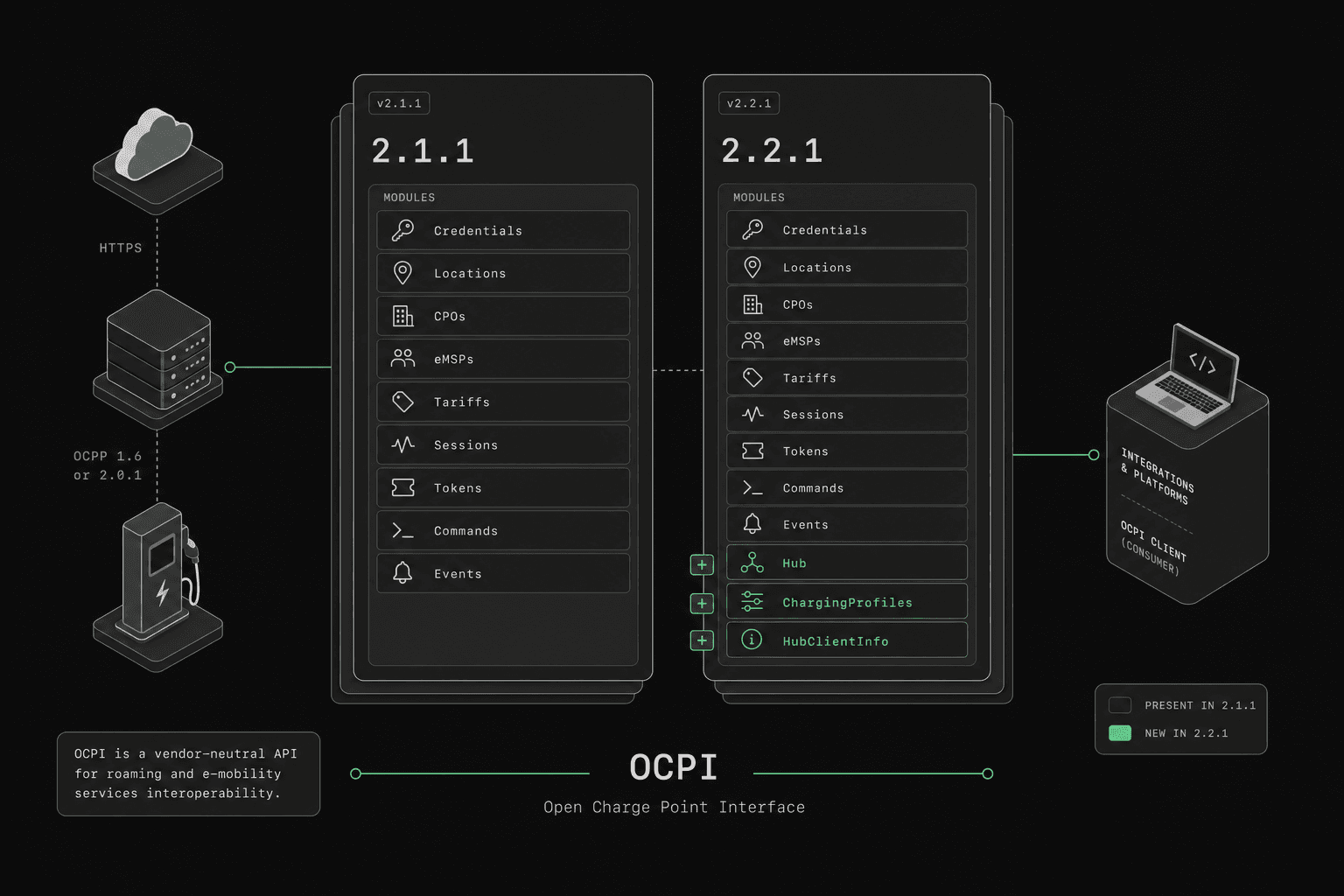
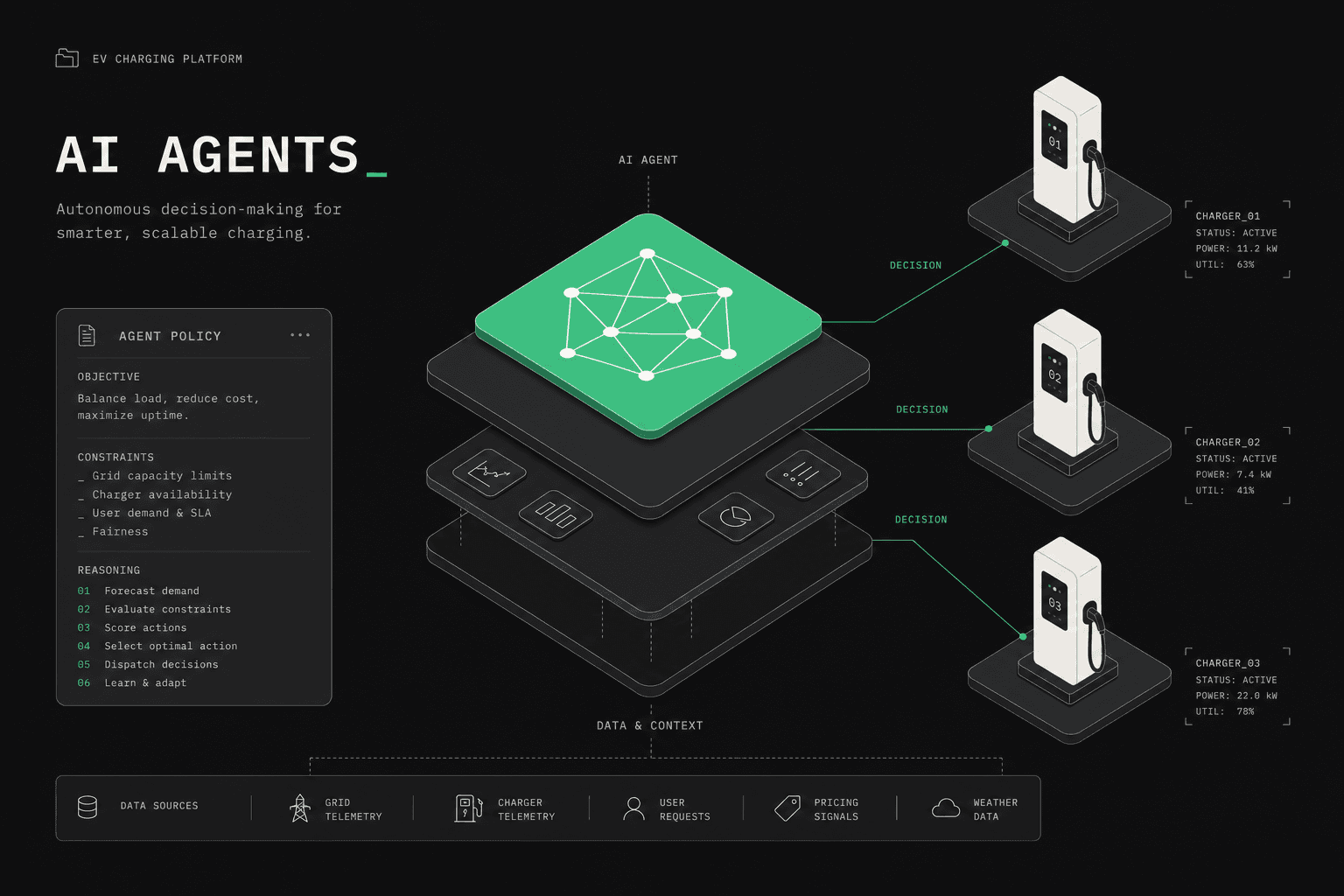
An OCPP AI agent for EV charging is software that watches the state of a charging network, decides what to do, and then acts on it through real protocols like OCPP, maintained by the Open Charge Alliance, and OCPI, governed by the EVRoaming Foundation. The difference from a normal script is that AI agents reason about messy, partial signals (a charger that boots but never starts a transaction, a roaming partner returning slow responses) and pick an action instead of following a fixed branch.
This guide covers where AI agents for EV charging actually help today, how one is built, the safety problem nobody mentions until something resets a live charger, and how to test an agent before it reaches production hardware. Throughout, the examples use virtual chargers in an OCPP simulator so you can watch agent behavior without touching real sites.
What Is an OCPP AI Agent in EV Charging?
Three properties separate an agent from automation you already have:
- It observes real telemetry. OCPP messages, StatusNotification streams, MeterValues, OCPI session and CDR data, monitoring probe results.
- It reasons under uncertainty. It maps a fault signature to a likely cause even when the logs are incomplete or the charger behaves out of spec.
- It takes actions through tools. It calls OCPP operations (RemoteStartTransaction, TriggerMessage, Reset), OCPI commands, or your own backend APIs, then checks whether the action worked.
That loop — observe, reason, act, verify — is what makes it an agent rather than a dashboard.
Where Do OCPP AI Agents Help EV Charging Today?
1. Fault diagnosis from OCPP telemetry
A charger goes Faulted, or boots and never transacts. An agent reads the recent OCPP exchange, the StatusNotification error codes, and the connector history, then proposes the likely cause: a failed Authorize, a misconfigured heartbeat interval, a meter value that stopped reporting. Instead of an operator grepping logs, the agent returns a ranked hypothesis with the evidence it used. See the OCPP error codes reference for the signatures these agents key off.
2. Automated CPMS and OCPP testing
This is the most production-ready use case right now. An agent reads a release diff or a protocol spec, generates the OCPP test scenarios that matter, runs them against your CPMS, and reports what broke. It can expand coverage into edge cases a human writes last: reconnect storms, malformed payloads, out-of-order messages. OCPPLab runs this pattern as AI-assisted OCPP test automation against virtual chargers.
3. Smart charging and energy optimization
An agent that holds site load limits, tariff windows, and live session demand can shape smart charging profiles — the same domain the ISO 15118 vehicle-to-grid standard addresses on the vehicle side — in response to conditions instead of a static schedule. It sets charging profiles through OCPP, watches the resulting load, and adjusts. The reasoning step matters here because the inputs (grid signals, driver deadlines, price) conflict and the right tradeoff changes by the minute.
4. Roaming and CDR reconciliation
Roaming disputes come from mismatched sessions and CDRs across partners. An agent can pull the OCPI Sessions and CDRs from both sides, line them up, and flag the specific field that disagrees (a timestamp, an energy total, a tariff lookup). That turns a manual reconciliation into a triaged queue.
5. Operator and driver support
A support agent grounded in your charger fleet state can answer "why did my session stop" with the actual OCPP trace behind that session, not a generic FAQ.
How Is an EV Charging Agent Built?
Most working agents share the same shape:
- Perception layer. Normalizes OCPP and OCPI traffic into structured events the model can reason over. Raw WebSocket frames are not enough; the agent needs session context, connector state, and history.
- Reasoning model. An LLM or SLM that takes the current state plus the goal and produces the next action. Model choice is a real decision, covered in the linked guide.
- Tools. Typed wrappers over OCPP operations, OCPI commands, and your internal APIs. The agent calls these; it does not write raw protocol by hand, because a hallucinated OCPP payload sent to a real charger is a problem.
- Memory. Recent actions and their outcomes, so the agent does not retry the same failed fix in a loop.
- Verification. After each action, the agent checks the resulting telemetry to confirm the action did what it intended.
The safety problem
An agent that can send RemoteStartTransaction or Reset can also send them to the wrong charger, at the wrong time, in a loop. OCPP actions move physical hardware and energy. A model that is usually right is still occasionally wrong, and the charger it gets wrong is at a real site with a real driver.
This is the reason most teams stall between a demo and production: the demo path is safe and the long tail is not.
Guardrails that make agents shippable
- Scoped permissions. The agent can read everything but can only write a small, explicit set of operations. RemoteStart yes, firmware update no.
- Human-in-the-loop for high-impact actions. Diagnose autonomously, but require approval before any action that changes hardware state.
- Dry-run and rate limits. Propose the action, show the predicted effect, cap how many real commands fire per minute.
- A sandbox. Run the agent against virtual chargers first, where a wrong Reset costs nothing.
How Do You Test an AI Agent Before Production?
You cannot validate an agent on a spreadsheet of prompts. You have to run it against chargers that behave like real ones — including the failure modes you are asking it to handle — and watch what it does.
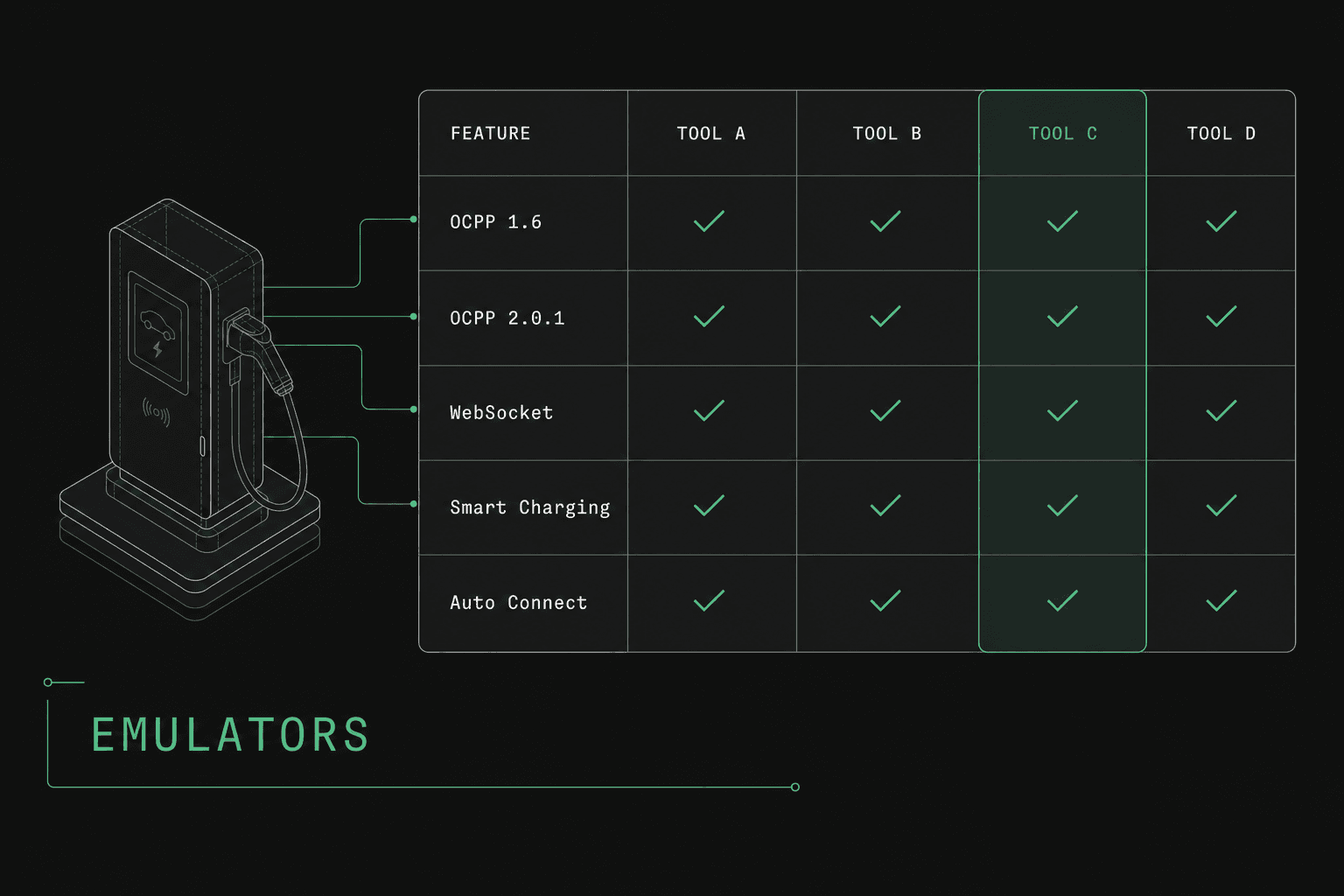
That is what an OCPP emulator is for. Deploy virtual chargers that reproduce the exact fault you want the agent to diagnose, let the agent act, and check whether its OCPP commands were correct, safe, and effective. Because the chargers are virtual, a wrong action is a logged event, not a field incident.
A practical test loop:
- Define the scenario as a set of virtual chargers in known states (one Faulted, one stuck after BootNotification, one with stalled MeterValues).
- Let the agent observe and act through OCPP.
- Assert on the agent's actions, not just its text: did it send the right operation to the right charger?
- Replay failures as regression cases so the agent does not lose a behavior on the next model update.
OCPPLab is built for exactly this: spin up virtual charger fleets, reproduce field bugs, and run agent behavior against them at scale before anything reaches a real site.
LLM or SLM for the reasoning model?
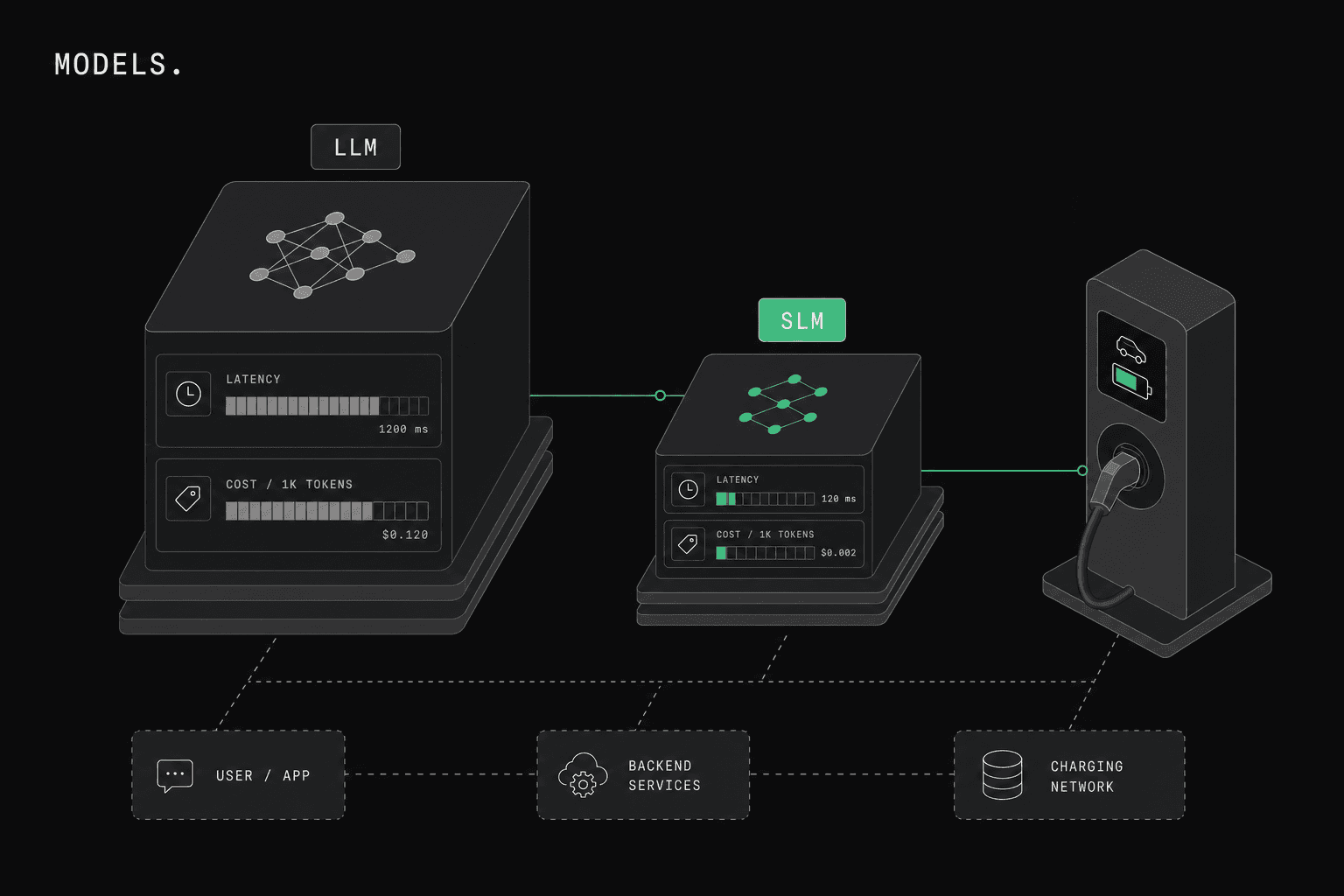
The model behind the agent drives its cost, latency, and where it can run. High-volume, narrow steps like fault classification often run better on a small model at the edge, while complex reasoning and test generation lean toward a large one. The right choice depends on the volume and complexity of the steps the agent runs.
Where OCPPLab fits
OCPPLab gives agents a safe place to act. Virtual chargers across OCPP 1.6 and OCPP 2.0.1, full OCPI roaming partners, monitoring probes, and replayable failure scenarios — the environment you need to build, test, and trust an EV charging agent before it touches production hardware.
Start your testing or see the platform features.