Quick answer: ISO 15118 is the communication standard between EVs and chargers that enables Plug and Charge — plug in and your EV automatically authenticates and starts charging with no app, RFID card, or credit card. It uses TLS encryption and X.509 certificates, requires OCPP 2.0.1 on the backend, and also enables Vehicle-to-Grid.
ISO 15118 is the International Organization for Standardization's communication standard between electric vehicles and charging stations. It enables Plug and Charge (PnC) — the ability to simply plug in your EV and have it automatically authenticate and start charging, with no app, RFID card, or credit card needed. The ISO 15118-20 revision (2022) extends the standard with full bidirectional / V2G support.
Think of it as the EV equivalent of tapping your phone to pay — except you just plug in the cable.
How Does Plug and Charge Work?
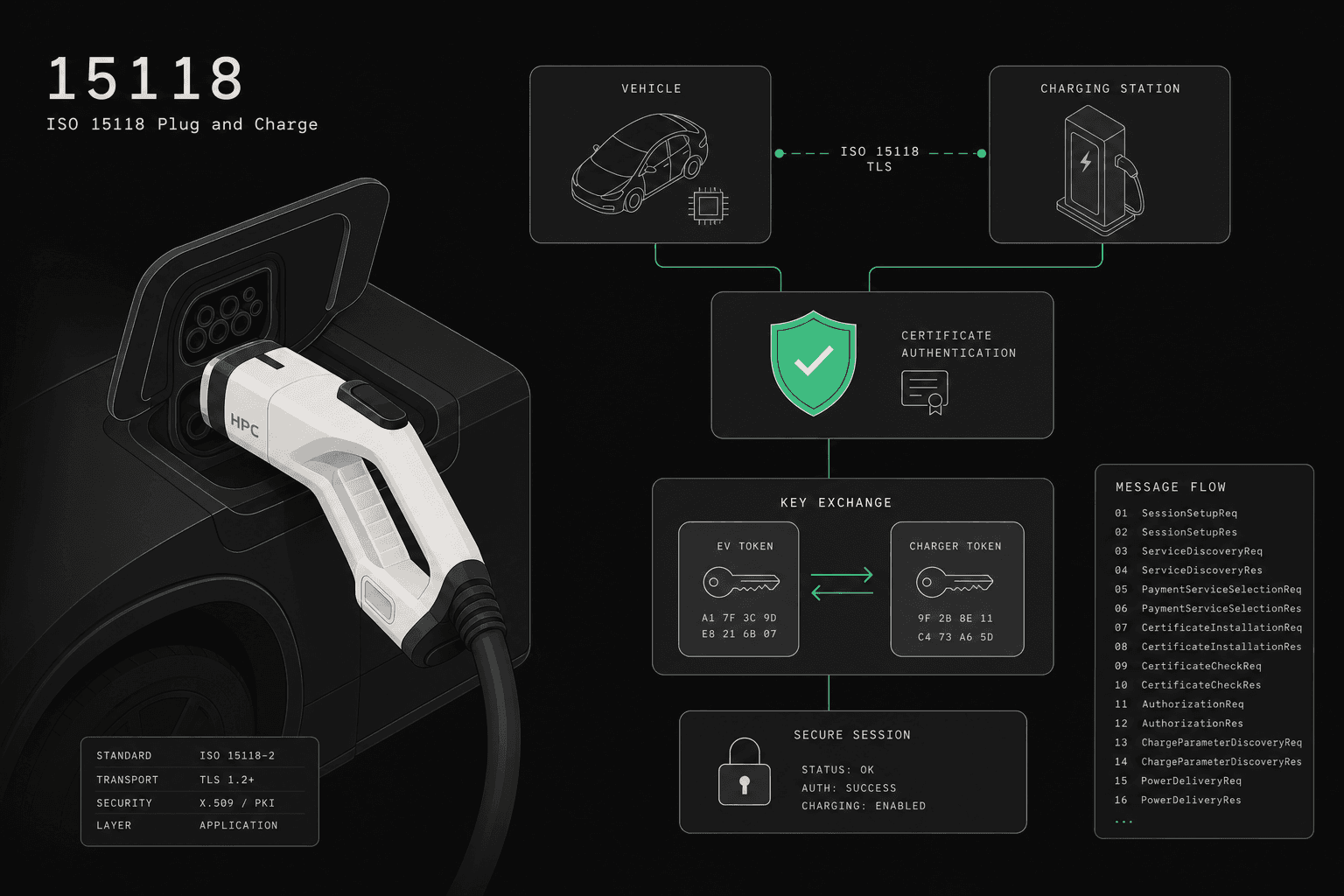
- Driver plugs in the charging cable
- Vehicle and charger establish a TLS-secured communication channel
- Vehicle presents its digital certificate (installed by the manufacturer or eMSP)
- Charger forwards the certificate to the CPMS for validation
- CPMS validates the certificate chain and authorizes the session
- Charging begins automatically — no user interaction needed
- Billing is handled via the contract associated with the vehicle's certificate
In practice the handshake completes in a few seconds, so the experience feels close to instant from plug-in to charging.
How Does ISO 15118 Work With OCPP?
Core OCPP 1.6 does not support ISO 15118. It lacks the message types needed for vehicle-side certificate provisioning (no Get15118EVCertificate). The optional OCPP 1.6 Security Whitepaper edition 2 does add SignCertificate, CertificateSigned, InstallCertificate, DeleteCertificate, and GetInstalledCertificateIds for CPMS-charger certificate management (see the OCA's Using ISO 15118 Plug & Charge with OCPP 1.6 whitepaper and our OCPP security profiles guide), but it does not include the EV-contract-certificate flow that Plug & Charge requires.
OCPP 2.0.1 has full ISO 15118 support including:
Get15118EVCertificate— Vehicle requests a new charging contract certificate (2.0.1-only)CertificateSigned— CPMS installs certificates on the charger (also in 1.6 Security Whitepaper edition 2)SignCertificate— Charger requests its own security certificate (also in 1.6 Security Whitepaper edition 2)- Certificate management for the entire PKI (Public Key Infrastructure) chain
| Feature | OCPP 1.6 | OCPP 2.0.1 |
|---|---|---|
| Plug and Charge | Not supported (no Get15118EVCertificate) |
Full support |
| CPMS-charger certificate management | Available via Security Whitepaper edition 2 (opt-in) | Complete PKI integration in core |
| Vehicle Communication | Not available | ISO 15118-2 and 15118-20 |
| Bidirectional Charging | Not supported | V2G ready |
What Is Vehicle-to-Grid (V2G)?
ISO 15118 also enables Vehicle-to-Grid (V2G) — the ability for EVs to send power back to the grid during peak demand. This requires:
- Bidirectional chargers (DC)
- ISO 15118-20 support (the latest revision)
- Grid operator integration
- OCPP 2.0.1 for backend communication
V2G turns every parked EV into a potential grid battery, helping utilities manage peak loads through smart charging and enabling EV owners to earn money by selling electricity back.
Testing ISO 15118 with OCPPLab
Testing Plug and Charge is complex because it involves:
- Certificate chain validation (Root CA → Sub-CA → Leaf certificates)
- TLS handshake between vehicle and charger
- OCPP 2.0.1 certificate management messages
- Multiple failure scenarios (expired certs, revoked certs, unknown CAs)
OCPPLab simulates the complete ISO 15118 flow including certificate exchange, allowing you to test Plug and Charge without physical vehicles or chargers.
Frequently Asked Questions
Which EVs support Plug and Charge?
A growing number of automakers — spanning both premium and mainstream brands — support Plug and Charge on select models, and the list continues to expand as ISO 15118 adoption widens. Check your specific vehicle and network for current support.
Is Plug and Charge secure?
Yes. ISO 15118 uses TLS encryption and PKI (Public Key Infrastructure) with X.509 certificates — the same security model used for HTTPS on the web.
Do I need OCPP 2.0.1 for Plug and Charge?
For the backend (CPMS) side, yes. OCPP 2.0.1 is required to manage certificates and process ISO 15118 authentication. The charger itself communicates with the vehicle via ISO 15118 directly.