The EV charging industry is rapidly evolving, and OCPP emulation has emerged as an increasingly popular approach to testing charging infrastructure. OCPP is the open communication standard maintained by the Open Charge Alliance; if you are new to it, our introduction to OCPP covers the basics. Here is why many teams now lean on virtual testing alongside traditional physical methods.
How Has OCPP Testing Evolved?
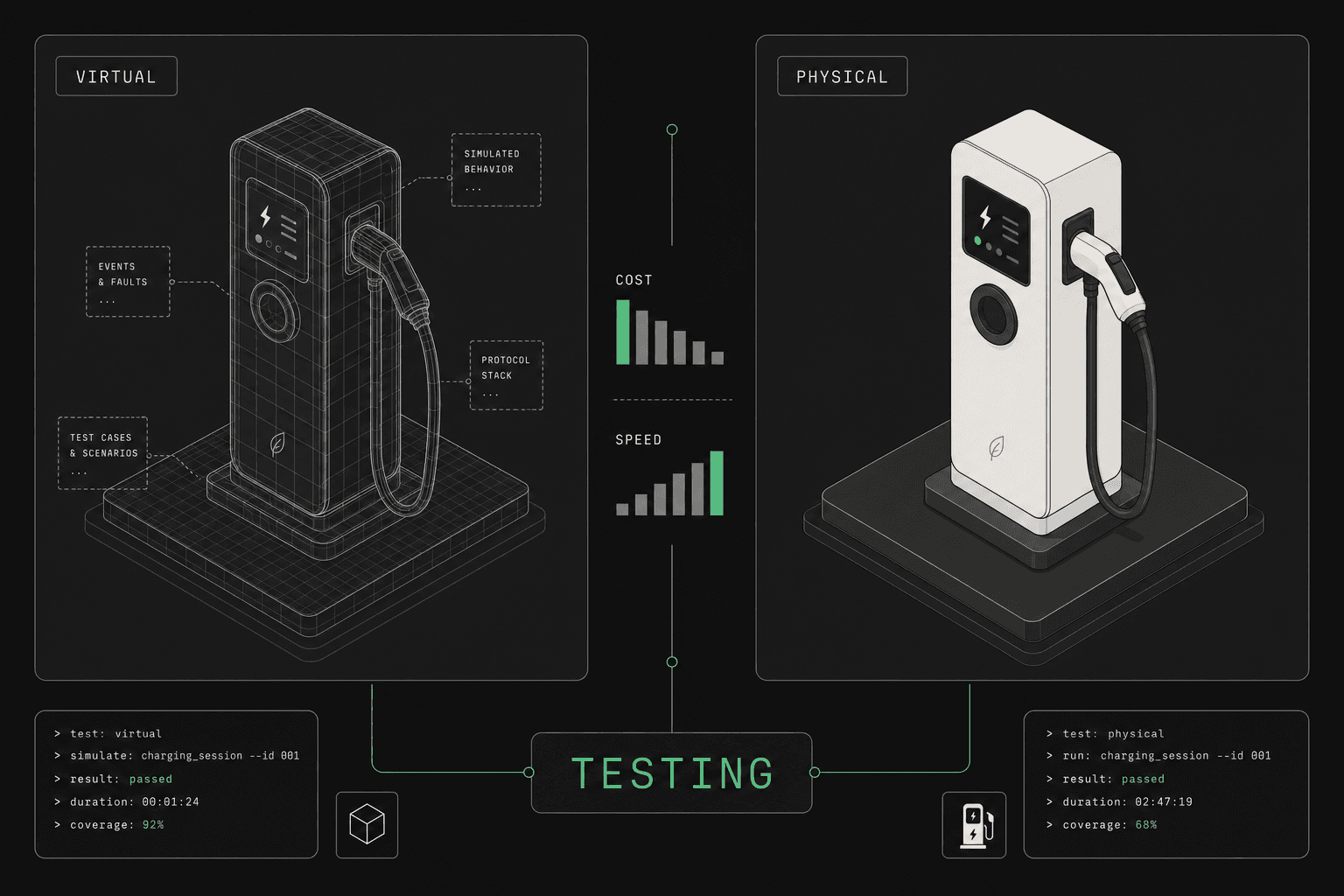
Traditional OCPP testing relied heavily on physical charging stations, which can create bottlenecks in development cycles. Emulation technology has changed this landscape, offering greater flexibility and efficiency for most test scenarios.
Traditional Testing Challenges:
- High Hardware Costs: Physical chargers, especially DC fast chargers, carry a substantial per-unit price
- Limited Availability: Waiting for hardware delivery and setup
- Space Constraints: Physical testing labs require significant space
- Maintenance Overhead: Hardware requires ongoing maintenance and updates
OCPP emulation can reduce these barriers, enabling faster, more comprehensive testing at a fraction of the cost.
What Are the Key Advantages of OCPP Emulation?
1. Cost Efficiency
Physical testing tends to become expensive quickly:
- Up-front hardware investment for a comprehensive testing lab
- Ongoing maintenance and support contracts
- Space rental and utilities for the lab
OCPP Emulation costs, by contrast, are typically dominated by a software license and standard development hardware, which can substantially lower the total cost of testing compared with a fully equipped physical lab.
2. Unlimited Scalability
With OCPP emulation, teams can test thousands of charging stations simultaneously, far exceeding what any physical test lab can accommodate.
Emulation allows you to:
- Test thousands of virtual charging stations simultaneously
- Simulate entire charging networks
- Validate system performance under realistic load
- Test edge cases that are difficult to reproduce physically
3. Rapid Development Cycles
The table below is illustrative of the relative differences teams often report, rather than a precise benchmark:
| Aspect | Physical Testing | OCPP Emulation |
|---|---|---|
| Setup Time | Weeks | Minutes |
| Test Execution | Hours to days | Minutes |
| Iteration Speed | Slow | Fast |
| Parallel Testing | Limited | Highly scalable |
4. Comprehensive Test Coverage
Emulation enables testing scenarios impossible with physical hardware:
- Network Failures: Simulate connectivity issues
- Power Outages: Test power loss recovery
- Firmware Corruption: Validate error handling
- Security Attacks: Test against malicious messages
- Extreme Load: Stress test with large numbers of concurrent sessions through OCPP load testing
Real-World Success Stories
The following are illustrative scenarios that reflect the kinds of outcomes teams describe, rather than figures from a specific published study.
Case Study: European CPO Network Migration
Challenge: Upgrade the CPMS to support OCPP 2.0.1 across a large-scale charging network. Where certification matters, the OCPP 2.0.1 certification program defines the conformance requirements.
Physical Testing Approach:
- A comprehensive testing programme measured in many months
- Significant hardware procurement budget required
- Higher risk of production issues
OCPP Emulation Approach:
- Testing completed in a fraction of that time
- Lower cost compared to physical testing
- Far fewer critical production issues
Result: Faster time-to-market with meaningful cost reduction
Case Study: European Charging Network
Challenge: Validate interoperability across more than a dozen charging station manufacturers
Emulation Benefits:
- Tested many manufacturer protocols in parallel
- Identified compatibility issues before hardware deployment
- Reduced field deployment failures considerably
- Saved a substantial sum in deployment costs
When Does Physical Testing Still Matter?
While emulation offers significant advantages, physical testing remains important for:
- Final Integration Validation: Confirming real-world hardware behavior
- Certification Requirements: Formal conformance through the OCA OCPP Certification Program is performed at designated test laboratories
- User Experience Testing: Validating actual user interactions
- Environmental Testing: Temperature, humidity, and weather resistance
Best Practice: Use emulation for the bulk of testing, and reserve physical hardware for final validation.
How Do You Make the Transition?
If your focus is validating a charging management system, our guide to CPMS testing walks through a practical workflow.
Step 1: Assess Current Testing Costs
Calculate your total physical testing expenses:
- Hardware procurement and depreciation
- Maintenance and support contracts
- Facility costs and utilities
- Personnel time for hardware management
Step 2: Plan Your Emulation Strategy
- Identify critical test scenarios
- Define virtual charging station profiles
- Plan integration with existing CI/CD pipelines
- Train team on emulation tools
Step 3: Implement Gradually
- Start with unit testing migration
- Expand to integration testing
- Eventually move load testing to emulation
- Maintain minimal physical setup for final validation
The Future is Virtual
The charging industry is moving toward virtual-first testing strategies. Teams that adopt emulation early often report:
- Noticeably faster development cycles
- Lower overall testing costs
- Broader test coverage
- Fewer critical production issues
For many teams the question is less whether to adopt OCPP emulation and more how quickly they can make the transition while staying competitive in the rapidly evolving EV charging market.