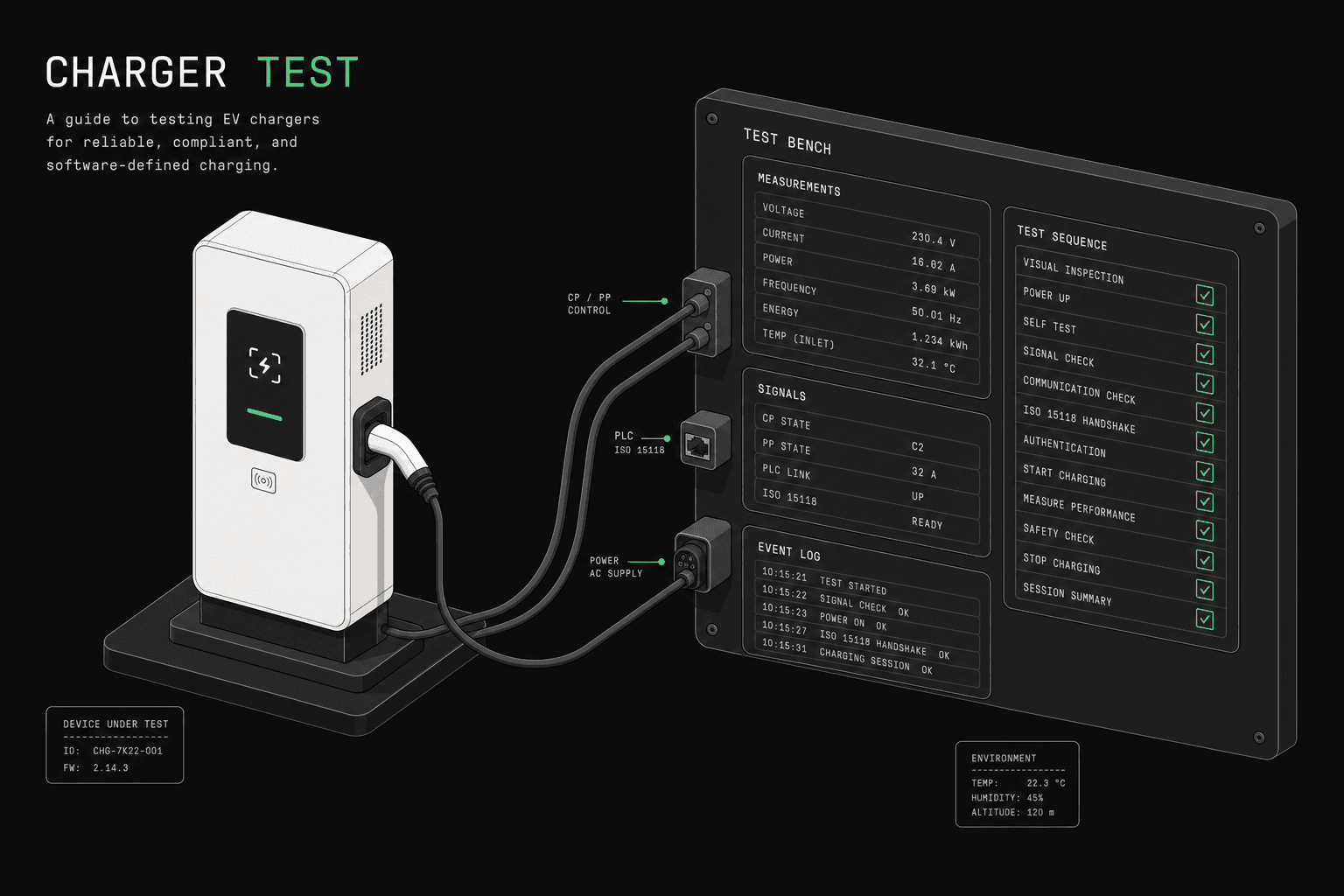
Quick answer: EV charger testing validates that charging stations, management systems (CPMS), and their integrations work correctly, securely, and at scale. The core methods are functional, load, compliance, integration, and regression testing. Combining virtual emulators with physical hardware validation catches the most issues, while CI/CD automation keeps every CPMS update from breaking existing functionality.
EV charger testing is the process of validating that charging stations, management systems (CPMS), and their integrations work correctly, securely, and at scale. As charging networks grow from dozens to thousands of stations, the cost of a single undetected bug multiplies — a firmware issue that bricks one charger is annoying, but one that bricks hundreds of chargers simultaneously is catastrophic.
Testing is not a one-time activity. Every CPMS update, every new charger model onboarded, and every protocol change requires regression testing to ensure nothing breaks. Organizations that invest in structured testing programs tend to detect far more issues before production than those relying on field testing alone.
Why Does EV Charger Testing Matter?
The consequences of inadequate testing are severe and measurable:
- Revenue loss: A charger offline at a busy location can lose meaningful revenue for every hour it stays down
- Driver frustration: Failed charging sessions are among the most common complaints from EV drivers
- Safety risks: Incorrect power management can damage vehicles or create electrical hazards
- Compliance failures: Industry organizations like the Open Charge Alliance and roaming platforms (GIREVE, Hubject) require protocol compliance
- Scaling failures: Systems that work with a handful of chargers often fail at thousands
What Are the Types of EV Charger Testing?
1. Functional Testing
Functional testing validates that individual OCPP operations work correctly in isolation and in sequence.
What to test:
- BootNotification and registration flow
- Authorization (RFID, app-based, Plug & Charge)
- Start and stop transaction flows
- MeterValues reporting accuracy and intervals
- StatusNotification transitions (Available, Preparing, Charging, Finishing, Faulted)
- Remote operations (RemoteStartTransaction, Reset, UnlockConnector)
- Firmware update lifecycle
- Configuration key management (GetConfiguration, ChangeConfiguration)
2. Load Testing
Load testing measures how your CPMS performs under realistic and peak traffic conditions.
What to test:
- Concurrent WebSocket connections (100, 500, 1,000, 10,000 charge points)
- Message throughput (MeterValues from all stations every 30 seconds)
- Database write performance under sustained load
- API response times during peak usage
- Memory and CPU utilization over extended periods
- Connection recovery after CPMS restart
3. Compliance Testing
Compliance testing verifies that your implementation follows the OCPP specifications precisely.
What to test:
- All required message fields are present and correctly typed
- Optional fields are handled gracefully when absent
- Error responses follow the OCPP error code specification
- Message sequencing adheres to protocol state machines
- Security profile implementation (Basic Auth, TLS client certificates)
- OCA certification test cases
4. Integration Testing
Integration testing validates end-to-end workflows across multiple system components.
What to test:
- Full charging session lifecycle (plug in to CDR generation)
- OCPI roaming flow (eMSP authorization through CPO charge point)
- Payment processing integration
- Energy management system integration (smart charging signals)
- Fleet management system integration
- Mobile app to CPMS to charge point flow
5. Regression Testing
Regression testing ensures that new changes do not break existing functionality.
What to test:
- All previously passing test cases after any code change
- Charger model-specific behaviors after CPMS updates
- Protocol version compatibility (1.6 and 2.0.1 simultaneously)
- Database migration integrity
- API backward compatibility
Physical vs Virtual Testing: Which Should You Use?
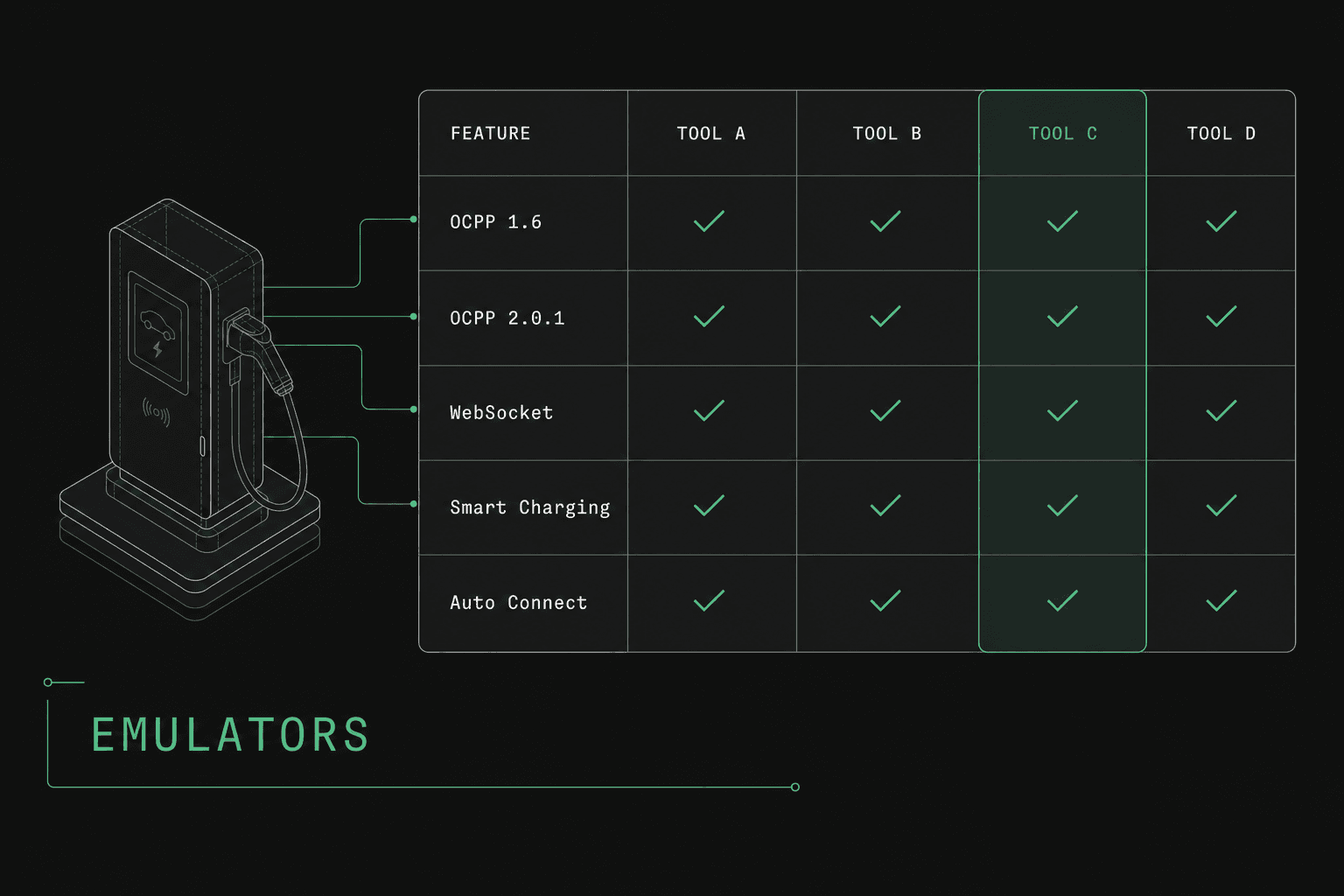
The traditional approach of testing with physical chargers is increasingly impractical. Here is how the two approaches compare:
| Aspect | Physical Testing | Virtual Testing (Emulators) |
|---|---|---|
| Setup Cost | $2,000-50,000 per charger | $0 per virtual station |
| Scale | Limited by hardware budget | 1,000+ stations instantly |
| Speed | Days to configure hardware | Minutes to deploy |
| Reproducibility | Low — hardware state varies | High — identical conditions every run |
| Edge Cases | Difficult to simulate faults | Easy — inject any error or delay |
| CI/CD Integration | Not practical | Native integration |
| Protocol Versions | Limited to charger firmware | Any version, any configuration |
| Concurrency | Limited by physical space and power | Unlimited parallel testing |
| Charger Models | One model per physical unit | Simulate 100+ models |
| Location | Requires lab or field access | Anywhere with internet |
Physical testing still has its place — final validation on actual hardware before deployment catches driver-facing UX issues and electrical integration problems that no emulator can replicate. The best testing strategy combines both.
How Do You Automate EV Charger Testing?
CI/CD Pipeline Integration
Every commit to your CPMS should trigger automated OCPP tests:
1. Developer pushes code
2. CI builds and deploys to staging
3. Virtual charge points connect automatically
4. Automated test suite runs (200+ test cases)
5. Results reported — pass/fail with detailed logs
6. Deploy to production only on full pass
Test Scenario Design
Structure your test scenarios in layers:
- Smoke tests (run on every commit): 10-20 critical path tests — boot, authorize, charge, stop
- Regression suite (run nightly): 200+ tests covering all OCPP operations
- Load tests (run weekly): Sustained traffic simulation with 1,000+ connections
- Compliance suite (run before releases): Full OCA certification test coverage
Common Bugs Found in CPMS Implementations
From testing hundreds of CPMS platforms, these are the most frequent issues:
| Bug Category | Example | Frequency |
|---|---|---|
| Message Parsing | Rejecting valid optional fields, incorrect date format handling | Very Common |
| State Management | Allowing RemoteStart on a Charging connector | Common |
| Concurrency | Race condition when two transactions start simultaneously | Common |
| Meter Values | Incorrect energy calculation from sampled vs clock-aligned values | Common |
| Reconnection | Losing transaction state when charge point reconnects | Frequent |
| Authorization Cache | Stale cache allowing revoked RFID tags | Frequent |
| Firmware Update | Not handling FirmwareStatusNotification timeouts | Frequent |
| Smart Charging | Incorrect composite schedule calculation with overlapping profiles | Common |
| Error Handling | Crashing on malformed JSON instead of returning CALLERROR | Very Common |
| Memory Leaks | WebSocket connections not properly closed on disconnect | Frequent |
What Are EV Charger Testing Best Practices?
1. Test with Multiple Charger Behaviors
Different charger manufacturers implement OCPP differently within the specification. Your CPMS must handle all valid variations:
- Some chargers send MeterValues every 10 seconds, others every 60 seconds
- Boot sequence timing varies between manufacturers
- StatusNotification transition patterns differ
- Optional message fields may or may not be present
2. Test Failure Scenarios Extensively
Happy-path testing catches only a fraction of production issues. Focus on:
- Network disconnection during active transactions
- Charger power loss and recovery
- Invalid or expired authorization tokens
- Concurrent operations on the same connector
- CPMS restart with active sessions
3. Maintain a Charger Compatibility Matrix
Track which charger models and firmware versions you have validated:
| Charger Model | Firmware | OCPP Version | Tested | Status |
|---|---|---|---|---|
| ABB Terra AC | 1.8.2 | 1.6 | Yes | Passed |
| EVBox Elvi | 5.1.0 | 1.6 | Yes | Passed |
| Wallbox Pulsar | 3.4.1 | 1.6 | Yes | Issues |
| Alfen Eve | 8.2.0 | 2.0.1 | No | Pending |
4. Monitor Production as a Testing Signal
Production is the ultimate test environment. Instrument your CPMS to detect:
- Failed transaction rates per charger model
- OCPP message error rates
- WebSocket disconnection frequency
- Average transaction duration anomalies
Testing with OCPPLab
OCPPLab is purpose-built for EV charger testing at scale. It provides:
- Virtual Charge Points: Deploy up to 1,000+ stations that behave like real chargers, supporting OCPP 1.6 and 2.0.1
- Device Model Library: Simulate specific charger brands and firmware versions with manufacturer-accurate OCPP behavior
- Scenario Engine: Script complex multi-step test scenarios including error injection, delays, and power fluctuations
- CI/CD Integration: Trigger test suites from your deployment pipeline and get pass/fail results programmatically
- Detailed Logging: Full WebSocket message capture with timestamps for debugging failed tests
Teams using OCPPLab report shortening their QA cycle from weeks to days, while increasing test coverage from a small set of manual tests to hundreds of automated scenarios. For a deeper walkthrough, see our complete guide to testing a CPMS.
Frequently Asked Questions
How many test cases do I need for a production CPMS?
A minimum viable test suite covers the core OCPP operations. A comprehensive suite for production readiness typically includes a few hundred test cases covering happy paths, error scenarios, edge cases, and charger-specific behaviors.
Should I test OCPP 1.6 and 2.0.1 separately?
Yes. While many message concepts are similar, the protocol differences are significant enough that separate test suites are necessary. Most CPMS platforms support both versions simultaneously, so your regression suite must cover both.
Can virtual testing replace physical testing entirely?
Not entirely. Virtual testing should handle the large majority of your validation — protocol compliance, load testing, regression, and edge cases. Physical testing is still necessary for final hardware integration validation, electrical safety verification, and driver-facing UX testing.
How often should regression tests run?
Smoke tests should run on every commit. Full regression suites should run at least nightly. Load tests should run weekly or before major releases. Compliance suites should run before any production deployment.
What is the cost of not testing?
A single critical OCPP bug reaching production can cost far more in emergency fixes, lost revenue, and customer churn than it would have cost to catch the same bug in testing — often by an order of magnitude or more.